Python for Staff Engineers
The definitive volume — architecture, trade-offs & decision records
What's inside
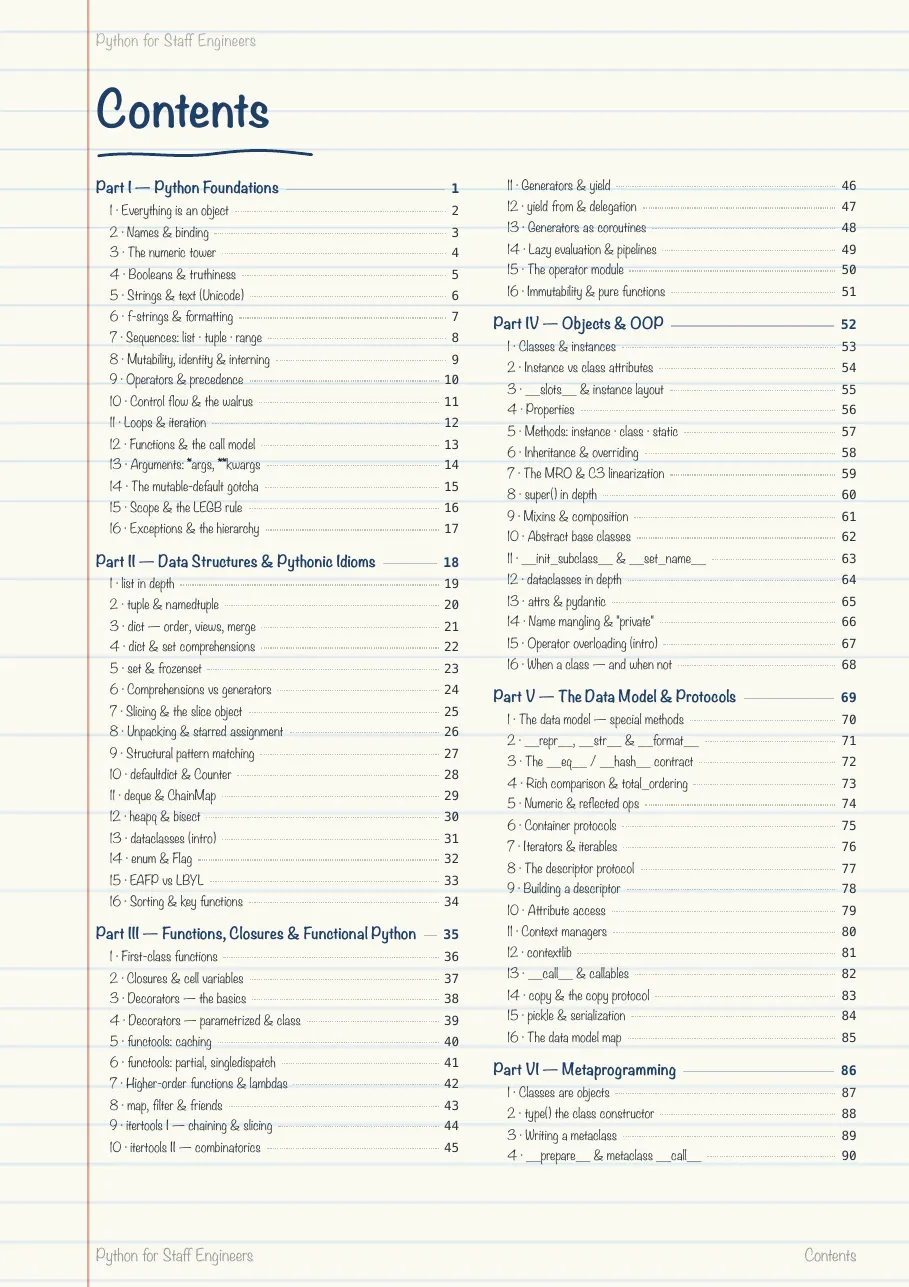
- Python at depth: performance, concurrency, and the runtime
- Trade-off cards, ADRs, and system-design case studies
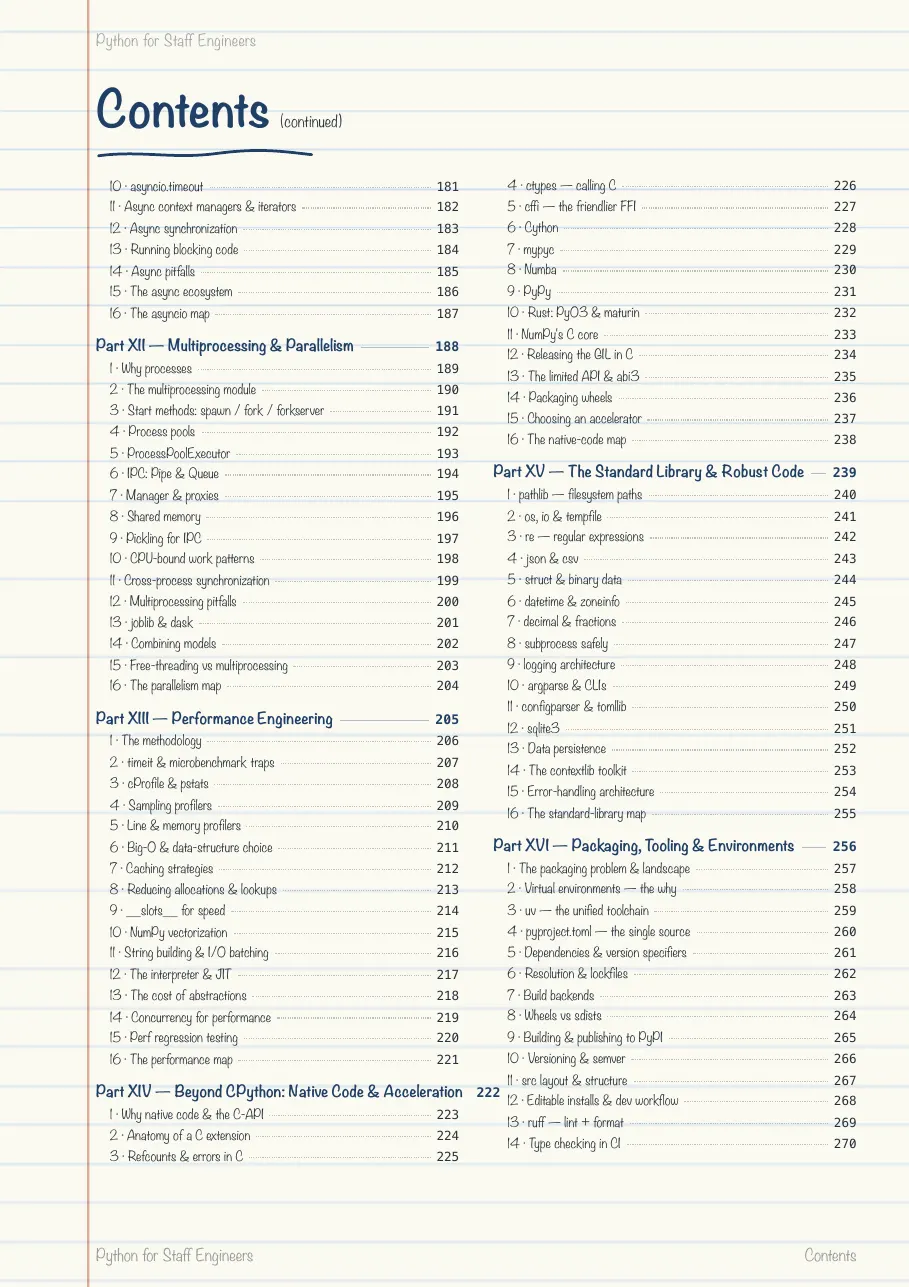
- Organised into parts, each with its own contents
- The reference you keep on the shelf for years
The parts
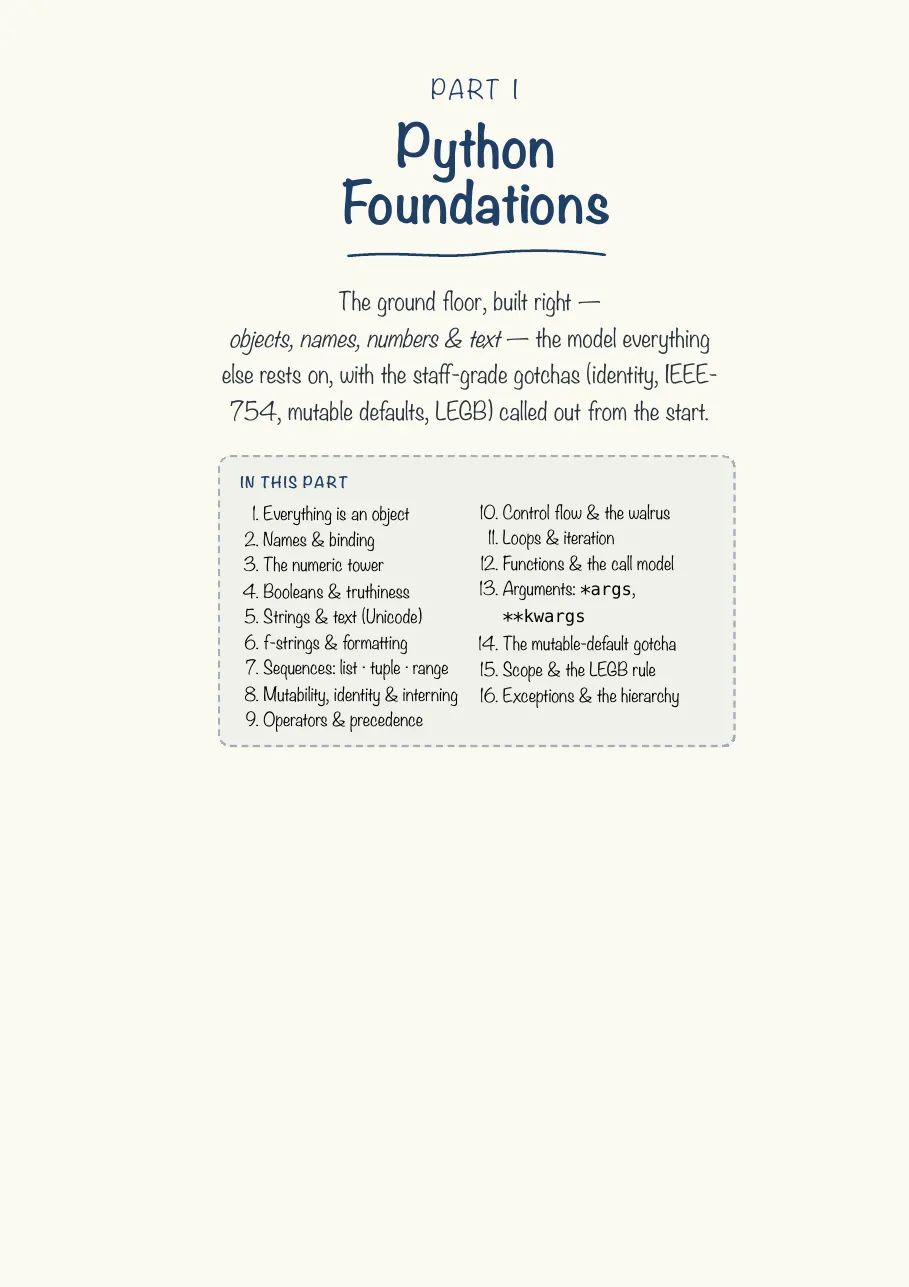
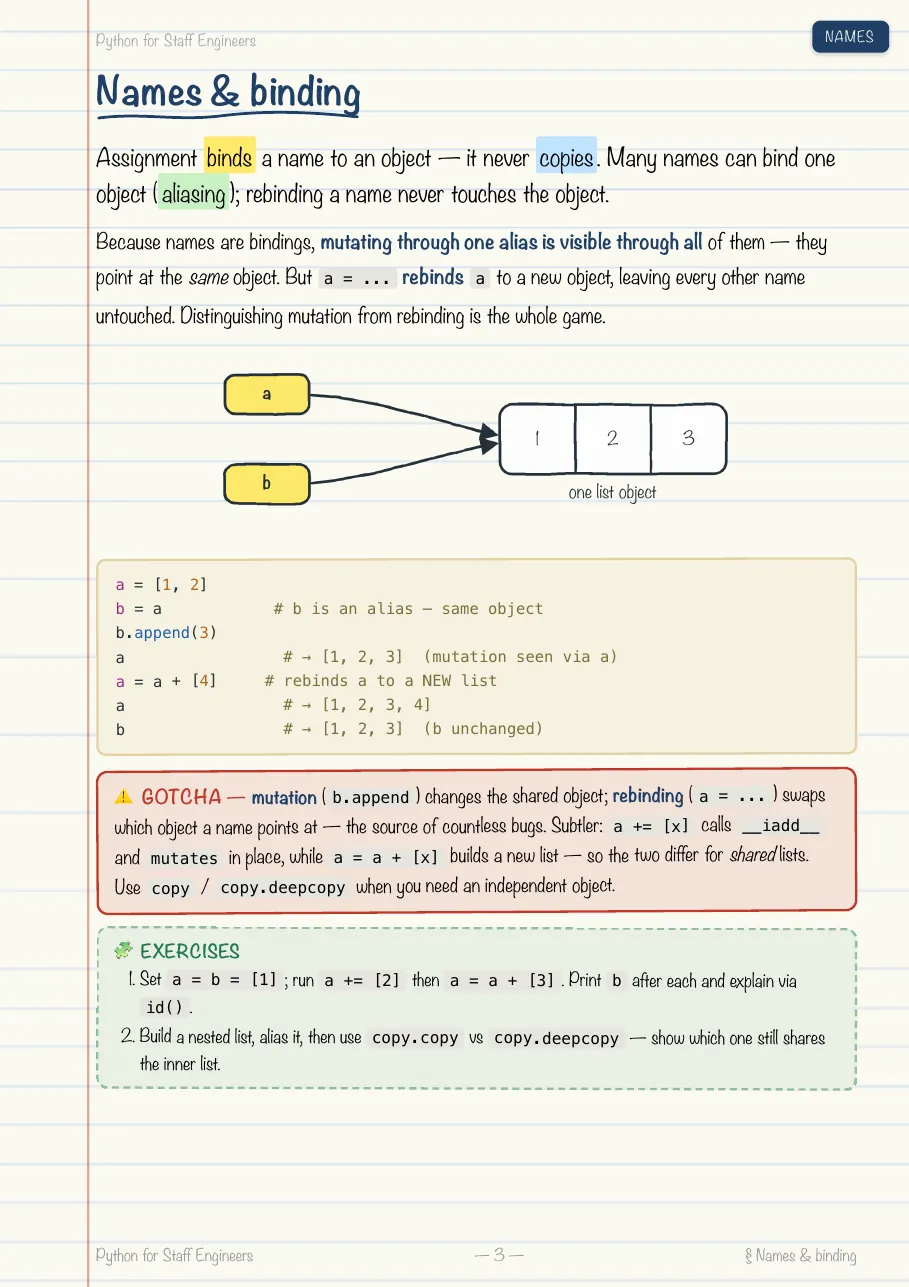
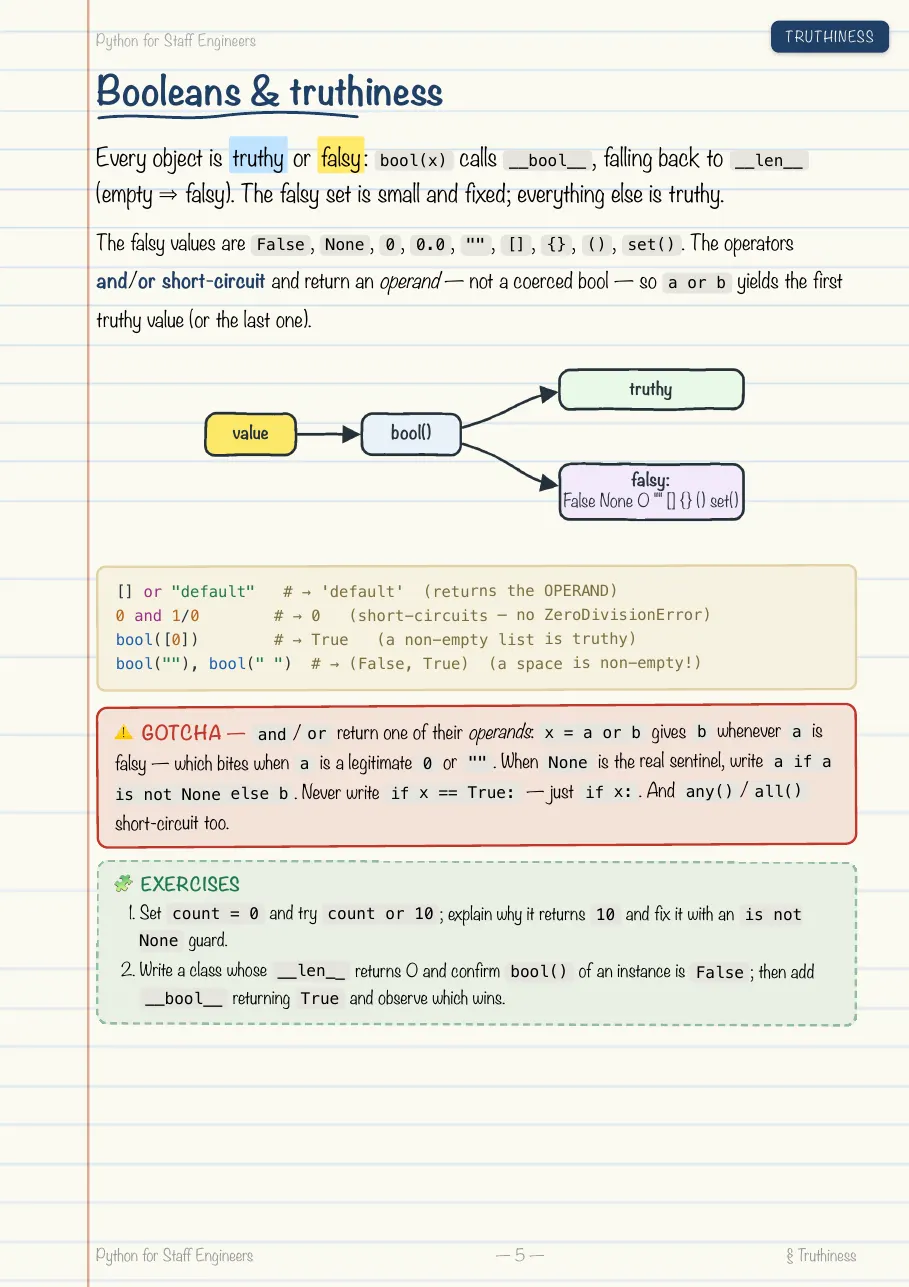
- Part I · Python Foundations The ground floor, built right — objects, names, numbers & text — the model everything else rests on, with the staff-grade gotchas (identity, IEEE-754, mutable defaults, LEGB) called out from the start.
- Part II · Data Structures & Pythonic Idioms The built-in containers in depth — dict, set, the collections toolkit — plus comprehensions, pattern matching, and the idioms that mark code as written by someone who knows Python.
- Part III · Functions, Closures & Functional Python Functions as values — closures, decorators, generators & the itertools toolbox — the functional core that makes Python expressive, and the lazy pipelines that make it scale.
- Part IV · Objects & OOP Classes done properly — the MRO, super() , descriptors-via-properties, ABCs — plus dataclasses and the judgement to know when a class is the wrong tool entirely.
- Part V · The Data Model & Protocols The dunder protocols that wire your objects into the language — operators, containers, iteration, descriptors, context managers — so your types feel native. This is the heart of Python.
- Part VI · Metaprogramming Code that writes code. Classes are objects, type is their maker, and the import system, inspect , and ast let you read and rewrite programs at runtime — power to wield sparingly .
- Part VII · Typing & Static Analysis at Depth Gradual typing as a design tool — generics, variance, protocols, narrowing — and the checkers (mypy · pyright · ty) that turn annotations into a safety net without changing what runs.
- Part VIII · CPython Internals I The Interpreter How CPython turns your source into running bytecode — tokenizer → PEG → AST → compiler → code object → ceval — and the object substrate, refcounts, specializing interpreter, and JIT underneath.
- Part IX · CPython Internals II Memory & Garbage Collection How objects are allocated and reclaimed — pymalloc arenas, refcounts, the cyclic generational GC — plus weakrefs, __slots__ , zero-copy buffers, and finding leaks with tracemalloc .
- Part X · Concurrency I Threads, the GIL & Free Threading The Global Interpreter Lock — what it protects, what it costs — threads, locks, queues, pools — when threading actually helps, and the no-GIL future (PEP 703) reshaping it all.
- Part XI · Concurrency II Asyncio & Async Python Cooperative multitasking on one thread — coroutines, the event loop, tasks, structured concurrency — scaling to thousands of concurrent I/O operations without a thread each.
- Part XII · Multiprocessing & Parallelism Real multi-core CPU parallelism by sidestepping the GIL with separate processes — start methods, pools, IPC, shared memory — and the serialization cost that comes with isolation.
- Part XIII · Performance Engineering Make it fast after you make it work — measure, profile, find the hotspot, optimize the algorithm — because intuition about where Python spends time is almost always wrong.
- Part XIV · Beyond CPython Native Code & Acceleration When pure Python is the floor — drop to C, Cython, Rust, or a different runtime — C-API, ctypes, Numba, PyO3, PyPy — and ship the compiled result as a wheel.
- Part XV · The Standard Library & Robust Code Batteries included — the stdlib modules that handle files, text, time, processes, logging, and data — plus the error-handling architecture that makes code robust.
- Part XVI · Packaging, Tooling & Environments How Python code becomes a shippable, reproducible artifact in 2026 — uv, ruff, ty, pyproject.toml, wheels & CI — the toolchain that turns a folder of .py files into a package others can trust.
- Part XVII · Testing, Quality & Correctness Proving the code actually works — and keeps working — unittest, pytest, mock, Hypothesis, coverage & CI — the discipline that turns "it ran once" into "it is correct, and a regression fails the build."
- Part XVIII · Design, Architecture & Patterns Structuring code that survives change — SOLID, composition, hexagonal architecture & the patterns Python makes trivial — where the staff engineer earns their title: choosing structure, recording the tradeoff, and keeping coupling low as the system grows.
- Part XIX · Python in Production Web, Data & Services Where Python actually lives — serving traffic and crunching data — WSGI/ASGI, FastAPI, SQLAlchemy, observability & the data stack — the architecture, the bottlenecks, and the operational reality of running Python under load.
- Part XX · Security, Reliability & the Staff Dimension Hardening what you ship, and the leadership that ships it — defensive security, supply chain, reliability patterns & the staff engineer's path — the dimension where correctness meets consequences and influence outweighs code.
- Part XXI · Capstone & Reference One real service that exercises the whole book — typed, tested, packaged, observable — then the master cheat sheets, the canon, and the path forward. Where every Part comes together in shippable code.
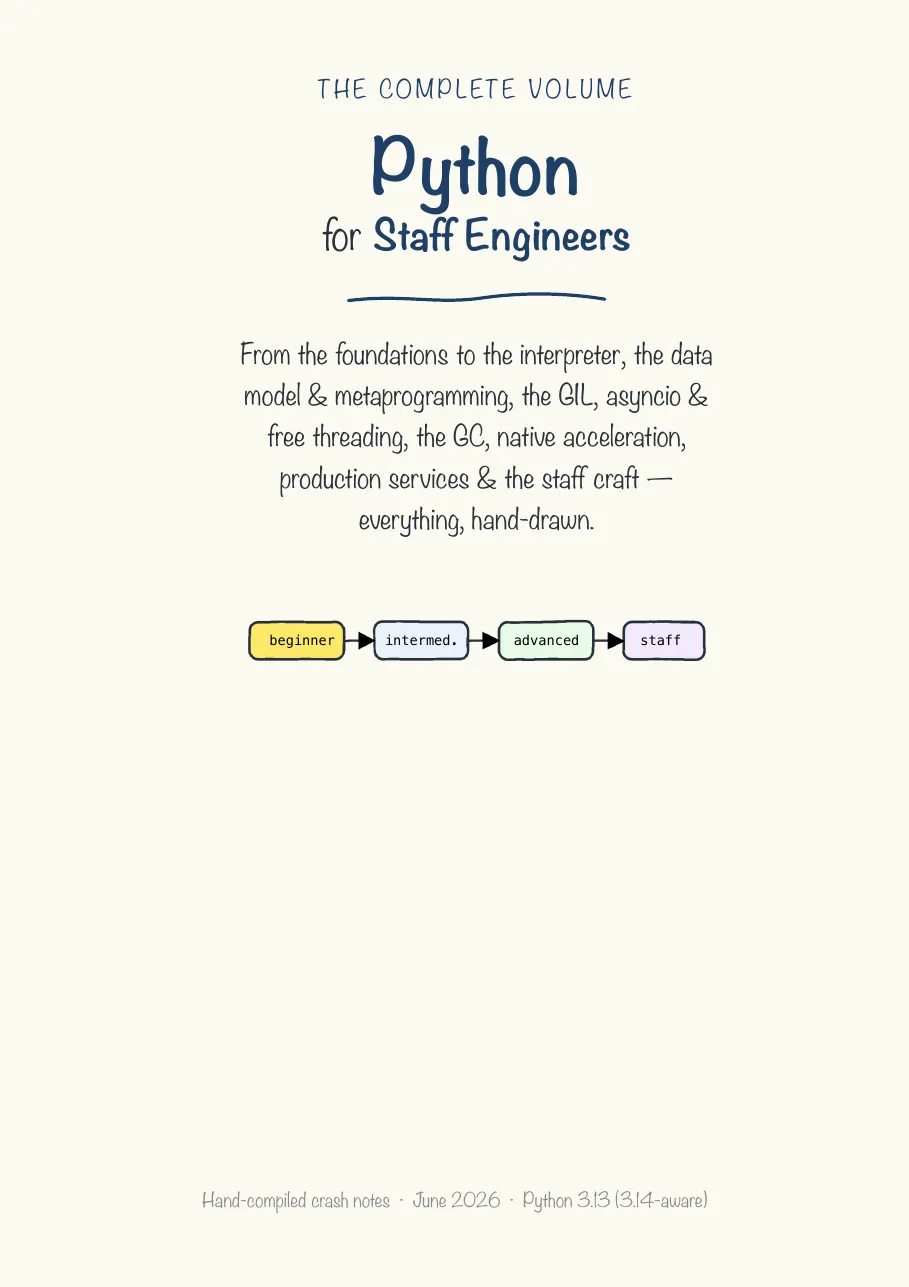
Python for Staff Engineers is the definitive volume: Python at the depth senior and staff engineers actually need — performance, concurrency, the runtime, plus trade-off cards, decision records, and system-design case studies.
Python is the lingua franca of data & scripting, and this book respects your time: no filler, no padding, just the parts that matter — in a handwritten style that’s genuinely enjoyable to read.
Preview a few pages below, then grab the PDF. You’ll have it in your inbox in seconds.
Questions
What makes the Staff edition different?
It goes beyond the language into architecture, trade-offs, decision records, and system-design case studies — the judgement senior+ engineers are paid for.
What format is the book?
A print-ready PDF — the same handwritten "Classic Ruled" style throughout. Read it on any device or print it.
Do I need an account to buy?
No. Buy with just your email; we send the download link instantly and let you create an account later to re-download anytime.
Can I get a refund?
Yes — see our refund policy. If the book isn't for you, reach out.